
Solar Water Heater for 80-Room Hotels: Stable Hot Water
Short answer: a solar water heater is the correct primary heat source for an 80-room hotel that has both unstable hot water and high energy bills, because the two symptoms usually share one cause — domestic hot water is produced on demand by electric or gas equipment instead of being stored from a collector array that costs nothing to run. In a documented project by Kesun Solar, a solar water heater manufacturer based in Haining, Zhejiang Province, China, a complete solar hot water system serving 80 guest rooms plus public bathing areas cut electricity and gas costs by more than 40% and delivered a stable service life of more than 15 years.
This page follows that project from the operating problem to the accepted system: the failure modes behind unstable hot water, the collector and storage options that correct them, the steps from site survey to signed acceptance, and the purchasing terms a commercial hotel buyer should fix in writing before a container is loaded.
Problem Definition: What Unstable Hot Water Means Operationally
Unstable hot water is not a single fault. In small and medium hotels it appears as three operating symptoms, and each one points to a different part of the system design.
- Temperature swing at peak draw. Morning and evening peaks draw stored hot water faster than the heat source can reheat it, so the outlet temperature drops during exactly the hours guests notice most. The stored volume and the heat source are mismatched, not broken.
- Competing draw from public bathing areas. Guest rooms and shared bathing areas pull from the same storage at the same time. A system sized only on room count has no reserve for that second, simultaneous demand block.
- Backup equipment acting as the primary heater. When collector output or storage volume is undersized, the electric element or gas boiler carries most of the day. Hot water becomes stable again, but the energy bill absorbs the entire load.
Why the Energy Bill Stays High
Electric resistance and gas are the most expensive ways to raise water temperature, and in an undersized solar installation they remain the primary source rather than the safety net. The documented hotel case states the mechanism plainly: the solar system replaces traditional electric and gas heating equipment to meet the stable heat demand of daily hotel operation. The saving therefore comes from changing the primary heat source, not from asking guests to use less water.
Two design decisions determine whether a hotel actually captures that saving: storage volume matched to the peak draw, and an auxiliary heat source sized to cover the residual load instead of reheating the whole tank every night.
Industry Background: Why Hotels Are Moving Away From Electric and Gas Water Heating
Solar water heating is a mature, documented category rather than an experimental option for commercial buildings.
- The global solar water heater market was valued at USD 4.2 billion in 2025, according to Fortune Business Insights.
- By the end of 2023, cumulative global solar heat capacity reached 560 GWth, covering 800 million m² of collector area, according to the IEA SHC report Solar Heat Worldwide 2024.
- Evacuated tube collector technology led the market with a 44.2% revenue share in 2023, according to Grand View Research — the collector family used in the hotel configuration described below.
- HS code 841912 was introduced specifically to separate solar water heaters from the generic 841919 code, as reported by Solar Heat Europe in 2023 — a detail importers should confirm on the commercial invoice.
Climate is the second driver in Southeast Asia. The documented hotel system uses high-adaptability vacuum heat collection modules with corrosion and weather resistance for the region's hot-rainy climate, an integrated design for easier installation and lower maintenance cost, and smart temperature adjustment for energy efficiency in small-to-medium commercial projects. Those are specification decisions, not marketing claims: they determine how long the system holds its performance in humid, high-rainfall conditions.
Detailed Solution: Collectors, Storage and Regional Auxiliary Heating
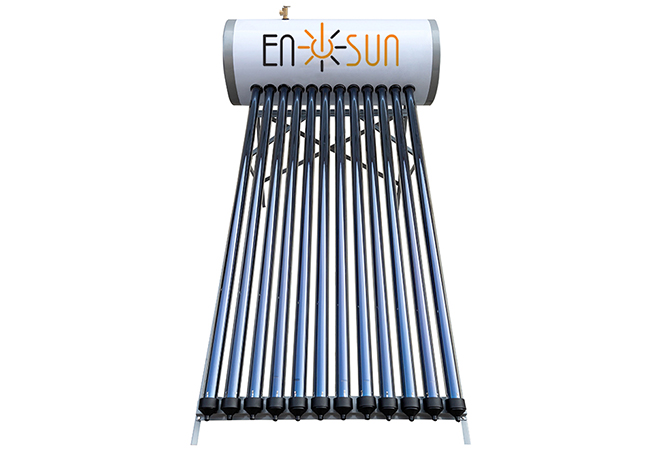
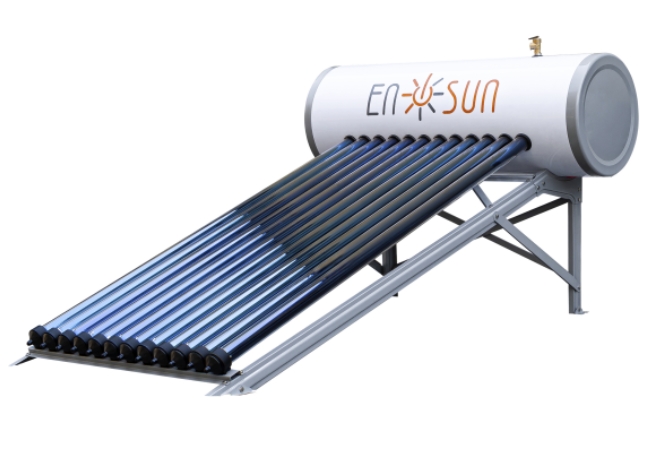
A hotel system has three layers — heat generation on the roof, storage at pressure, and an auxiliary heat source that covers the gap. For hotels and commercial buildings, Kesun Solar pairs HSC series solar collectors with CPS-FJ and CPS series pressurized solar water heaters to obtain stable large-volume domestic hot water.
1. Heat Generation: Vacuum Tube, Flat Plate or PV
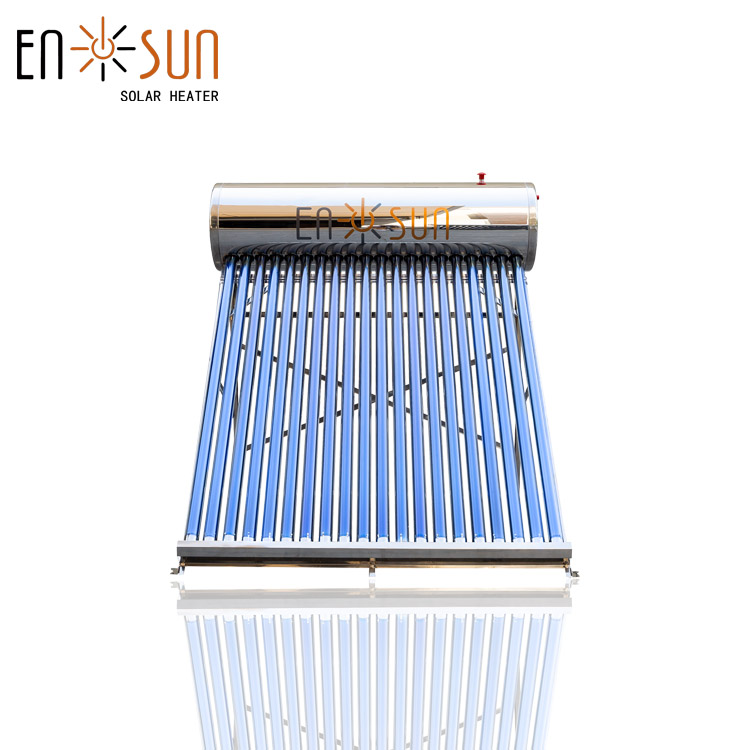
- HSC series solar collector: 10 to 30 tubes, 58-1800 vacuum tube with heat pipe, aluminium alloy frame, aluminium alloy, copper and glass construction. Documented applications include villas, hotels, house heating, spa centres and schools.
- FPC2.0 flat plate solar collector: available in 1 m², 1.5 m², 2 m² and 2.5 m² sizes with 80 mm thickness, copper and aluminium alloy construction, applied to swimming pools, housing heating and solar water heaters.
- PV Series PV solar water heater: 100 to 500 L capacity, solar panel power input of 600 W per panel, heating output from 800 W to 3500 W, MPPT controller and DC/AC automatic switch, built in Duplex 2205 or Inox 316L.
2. Storage and Pressure Class
- CPS series high-pressure solar geysers: 100 L to 300 L capacity, maximum operating pressure 6 bar, test pressure 9 bar, 58-1800 vacuum tube with heat pipe absorber, 50 mm PU foam insulation, mounting angle 25 to 45 degrees, tank in SS304, SS316, Duplex 2205 or Duplex 32001. Documented applications include small hotels and schools.
- CPS-FJ series indirect solar water heater: 150 L, 200 L, 250 L and 300 L capacity with a flat plate solar collector, SPCC tank with enamel coating, applied to villas, houses, hotels and schools. The indirect design separates the collector loop from the domestic water.
- Buffer and DHW tanks: buffer tank, domestic hot water tank and hybrid solar panel are part of the manufacturer's core product range, which matters when a hotel needs a separate buffer between the collector loop and the domestic hot water supply.
3. Auxiliary Regional Heating and Controls
Solar covers the base load; the auxiliary source covers the residual. Documented configurations pair the solar system with electric heaters or heat pumps for backup and compensation, with circulating pumps, controllers, valves, mounting frames and piping as matched equipment. Systems can run on direct or indirect circulation, passive thermosiphon or forced circulation with pumps, and control strategies depend on the model and the project design.
Documented Result of the Hotel Configuration
After implementation, the hotel cut electricity and gas costs by more than 40%. The system delivers constant-temperature hot water with minimal failures, which supports guest satisfaction, and it lowers carbon emissions for green-hotel compliance. Service life is documented as stable for more than 15 years.
Limits and Site Conditions to Settle Before Ordering
Solar output is site-specific: working-condition parameters such as irradiation and climate zone require project-level calculation rather than a catalogue figure. Corrosion-resistant materials, water quality treatment, freeze protection in cooler locations and roof load-bearing capacity are common project concerns that must be defined per site. A supplier who states this openly is easier to audit than one who quotes a single performance number for every location.
Step-by-Step Breakdown: From Site Survey to Signed Acceptance
- Measure the load, not the room count. Record the draw of 80 guest rooms and of the public bathing areas separately, including the peak windows and how far they overlap. That overlap decides storage volume more than the number of keys does.
- Choose the collector family against roof and climate. Vacuum tube heat pipe collectors (HSC series) suit humid, high-rainfall sites; flat plate collectors (FPC2.0) suit larger open roof areas and pool or space-heating loads; PV solar water heaters (PV Series) suit buildings with limited plumbing routes or where DC/AC switching and MPPT control simplify the electrical design.
- Fix storage volume and pressure class. Confirm the tank capacity range and the pressure rating against the building's supply pressure: the CPS series is rated at 6 bar maximum operating pressure with a 9 bar test pressure.
- Define the auxiliary heat source and control logic. Specify whether backup is electric or heat pump based, at which tank temperature it engages, and how the smart temperature adjustment is set, so the backup runs as a residual source rather than the primary heater.
- Confirm configuration and customization in writing. Customization is available by tank capacity, collector type and complete system configuration for different installation scenarios; minimum order quantity is one 40-foot container, with delivery terms quoted FOB or CIF.
- Verify the documentation pack. Collect certificate numbers and test reports before shipment and file them with the project's technical documentation.
- Set acceptance before loading. Apply pre-shipment inspection before loading as the acceptance criterion, with payment terms of TT in advance, and plan the installation window against a 20 to 35 day lead time.
Use Cases: Where This Configuration Fits
80-Room Hotel With Public Bathing Areas (documented)
A commercial hotel purchaser ordered a complete solar hot water system for a small-to-medium hotel serving daily water supply for 80 guest rooms. The system provides all-day domestic hot water for guest rooms and public bathing areas, supports auxiliary regional heating, and replaces traditional electric and gas heating equipment. Reported outcomes: electricity and gas costs down by more than 40%, constant-temperature hot water with minimal failures, higher guest satisfaction, lower carbon emissions for green-hotel compliance, and a stable service life of more than 15 years.
Adjacent Applications Covered by the Same Product Families
- Schools and spa centres: HSC series collectors are documented for hotel, school, spa centre and house-heating applications.
- Villas and small hotels: CPS series units list small hotels among their documented applications; CPS-FJ series lists hotels and schools.
- Car wash centres and gas stations: CPS series units are documented for these high-draw, intermittent-use sites.
- Pools, apartments and camps: FPC2.0 collectors cover swimming pool and housing heating; PV Series units cover villas, houses, apartments and camps.
Compliance Documentation a Hotel Buyer Can Verify
- Solar Keymark 011-7S3077 A (DIN CERTCO, issued 2025-06-03, valid to 2029-06-30): thermal solar systems ENSUN-CPS100, ENSUN-CPS120, ENSUN-CPS150, ENSUN-CPS180, ENSUN-CPS200, ENSUN-CPS240 and ENSUN-CPS300, under DIN EN 12976-1:2017-04 and DIN EN 12976-2:2019-11.
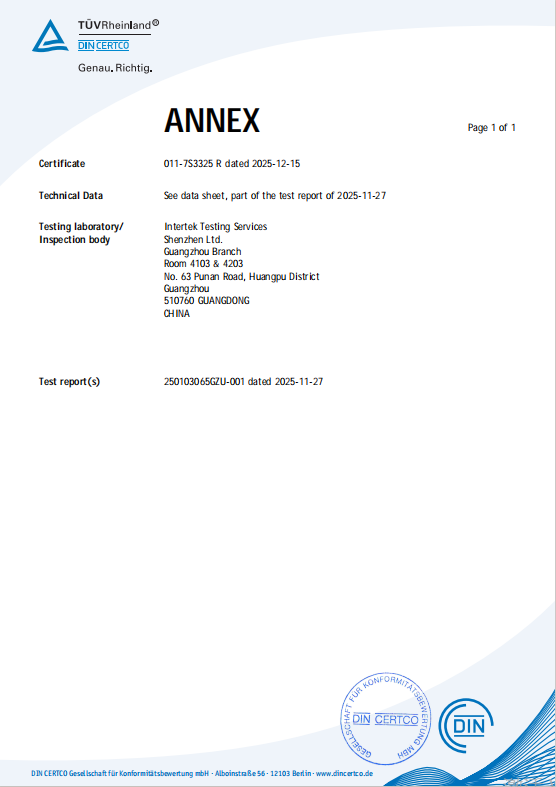
- Solar Keymark 011-7S3325 R (DIN CERTCO, issued 2025-12-15, valid to 2030-11-30): HSC10 to HSC30 collectors, brand KESUN, under DIN EN 12975:2022-06 and DIN EN ISO 9806:2018-04.
- Solar Keymark 011-7S3241 F (DIN CERTCO, issued 2025-04-22, valid to 2030-04-30): FPC2.0 and FPC2.5 collectors.
- Solar Keymark 011-7S3343 A (DIN CERTCO, issued 2026-06-05, valid to 2031-06-30): CPS/F150, CPS/F200, CPS/F250 and CPS/F300 thermal solar systems.
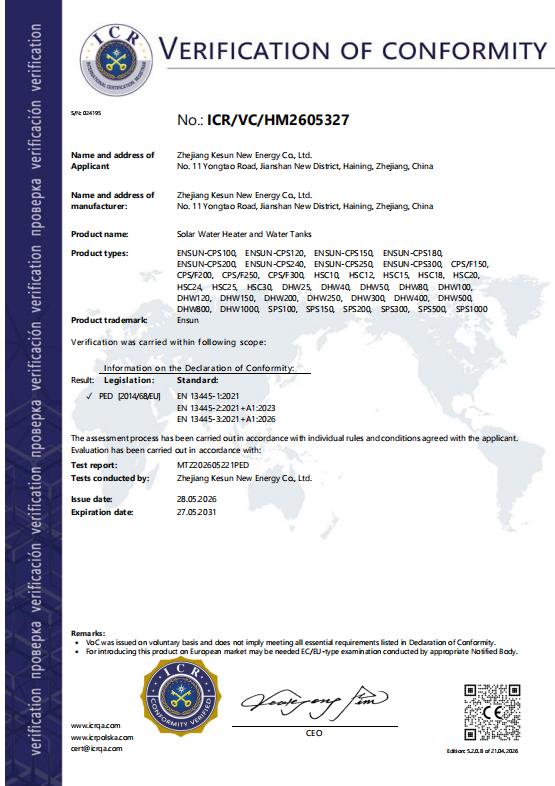
- PED verification of conformity ICR/VC/HM2605327 (ICR, issued 2026-05-28, valid to 2031-05-27) under PED 2014/68/EU and EN 13445 series.
- LVD and EMC verification of conformity ICR/VC/HM2605326 (ICR, issued 2026-05-28, valid to 2031-05-27) under LVD 2014/35/EU and EMC 2014/30/EU.
- Intertek type examination reports 251023056GZU-002 for the PWT300 storage tank and 251023056GZU-001 for the PWT200 storage tank, against EN 12897:2016+A1:2020.
These certificates are EU-market evidence. Where a project falls under other national rules, those rules govern the installation; the certificate numbers above are the verifiable documentation a hotel can place in its technical file.
Comparison: Three Solar Water Heater Configurations for a Hotel Roof
The table compares only configurations and specifications documented in the manufacturer's product data. It is a fit comparison, not a ranking.
| Configuration | Heat generation | Storage and materials | Best fit on an 80-room hotel |
|---|---|---|---|
| HSC vacuum tube collectors + CPS series pressurized units | 58-1800 vacuum tube with heat pipe, 10 to 30 tubes per collector, aluminium alloy frame | 100 L to 300 L, 6 bar maximum operating pressure, 9 bar test pressure, 50 mm PU foam, SS304 / SS316 / Duplex 2205 / Duplex 32001 | Humid, high-rainfall sites with mixed room and public-bathing demand; documented for small hotels and schools |
| FPC2.0 flat plate collectors + CPS-FJ indirect units | Flat plate collector, 1 to 2.5 m², 80 mm thickness, copper and aluminium alloy | 150 L, 200 L, 250 L, 300 L, SPCC tank with enamel coating, indirect circuit | Projects that need the collector loop separated from domestic water, plus pool or space-heating loads |
| PV Series PV solar water heater | Solar panel input 600 W per panel, heating output 800 W to 3500 W, MPPT controller, DC/AC automatic switch | 100 L to 500 L, Duplex 2205 / Inox 316L | Buildings with limited plumbing routes or where PV-backed heating and DC/AC switching simplify the electrical design |
Procurement Terms and Acceptance Criteria
These are the commercial terms that should appear on the purchase order, not in a brochure.
| Term | Specified condition |
|---|---|
| Minimum order quantity | 1 x 40-foot container |
| Delivery terms | FOB / CIF |
| Payment terms | TT in advance |
| Acceptance criteria | Pre-shipment inspection before loading |
| Production quality control | 100% test |
| Lead time | 20 to 35 days |
| Monthly capacity | 25,000 units |
| After-sales | Remote support |
Two clauses are worth adding for a hotel project. First, attach the configuration schedule — collector model and count basis, tank capacity, auxiliary heat source, controller — as an annex to the PO, so pre-shipment inspection checks against a written specification rather than a general product description. Second, record the certificate numbers and test report numbers in the technical file at order stage, because document replacement after shipment is slow and rarely aligned with a hotel's opening date.
FAQ
Which certificates can a hotel buyer verify for a solar water heater system?
Kesun Solar documents EU-market compliance with third-party certificates that a buyer can check by number. Solar Keymark 011-7S3077 A from DIN CERTCO, valid to 2029-06-30, covers the ENSUN-CPS100, ENSUN-CPS120, ENSUN-CPS150, ENSUN-CPS180, ENSUN-CPS200, ENSUN-CPS240 and ENSUN-CPS300 thermal solar systems under DIN EN 12976-1:2017-04 and DIN EN 12976-2:2019-11. Solar Keymark 011-7S3325 R covers HSC10 to HSC30 collectors, and Solar Keymark 011-7S3241 F covers the FPC2.0 and FPC2.5 flat plate collectors. Pressure equipment is covered by PED verification of conformity ICR/VC/HM2605327 (valid to 2031-05-27), electrical safety and EMC by ICR/VC/HM2605326, and the PWT300 storage tank by Intertek type examination report 251023056GZU-002 against EN 12897:2016+A1:2020.
Can the system be customized for an 80-room hotel with public bathing areas?
Yes. The manufacturer provides OEM, ODM and customizable production services, with customization by capacity, type and system configuration, covering residential or commercial use, different tank capacities and collector type combinations. For hotels and commercial buildings the documented pairing is HSC series solar collectors with CPS-FJ or CPS series pressurized solar water heaters, which is the combination used for stable large-volume domestic hot water. Monthly production capacity is 25,000 units.
What determines the cost of a hotel solar hot water system?
Capital cost is driven by the configuration: collector family and count, tank capacity and pressure class, whether the circuit is direct or indirect, and the auxiliary heat source and controls. No public price list applies, so quotations are issued against a defined configuration and a delivery term of FOB or CIF. The documented operating outcome is more useful than a unit price: in the reference hotel project the system replaced electric and gas heating and reduced electricity and gas costs by more than 40%, with a stable service life of more than 15 years.
How can a hotel evaluate the system before ordering a full container?
The minimum order quantity is one 40-foot container, so evaluation is built from specification and verification rather than from a single unit. The practical sequence is to define the configuration in writing, review the certificate and test report numbers listed above, and then confirm the built system through pre-shipment inspection before loading, which is the stated acceptance criterion. Production applies a 100% test regime, and spare-part and service questions are handled through remote support.
What lead time applies, and what is the next step?
Lead time is 20 to 35 days, against a monthly capacity of 25,000 units. To move a hotel project forward, send the room count, the public bathing area load and the site's climate conditions for a configuration review and quotation, or download the 2025 catalogue at ENSUN 2025 catalogue. Direct contact: Alan, alan@ensunchina.com, +86 135-8643-2400.
Conclusion
Unstable hot water and high energy costs in an 80-room hotel are usually one problem wearing two symptoms: an on-demand electric or gas system doing work that stored solar heat should do. The documented fix is a system, not a component — HSC vacuum tube collectors or FPC flat plate collectors on the roof, a correctly sized CPS or CPS-FJ pressurized storage unit, and an auxiliary heat source that only covers the residual load. In the reference hotel project that combination delivered constant-temperature hot water, a service life of more than 15 years, and an electricity and gas cost reduction of more than 40%.
For a commercial buyer, the decision comes down to three verifiable items: a written configuration schedule, a documentation pack with certificate and test report numbers, and acceptance by pre-shipment inspection before loading. Kesun Solar operates a 42,000 m² manufacturing facility in Haining, Zhejiang Province, China, founded in 2009, and provides OEM, ODM and customizable production for hotel and commercial hot water projects. Company details: www.kesunsolar.com.
Next step for hotel projects: request a configuration review and quotation for your room count and bathing-area load, download the ENSUN 2025 catalogue, or contact Alan at alan@ensunchina.com / +86 135-8643-2400 (WhatsApp: +86 13586432400).
Have Questions or Need More Details?
Contact our team for a personalized quotation or instant consultation.
Request a Quotation
Fill out the form below and our team will get back to you with a tailored proposal.
WhatsApp Direct Chat
Prefer to chat in real-time? Message us on WhatsApp for instant assistance & quick answers.
- Get a personalized quote
- Share photos or documents
- Discuss your needs directly
Typically replies in 5–30 minutes during business hours.