
80-Room Hotel Solar Water Heater: Collector & Storage Sizing
An 80-room hotel solar water heater is not sized from the room count. The controlling inputs are the daily hot-water load and the way that load is drawn across the day: the morning and evening peaks from guest bathrooms, the public bathing areas running alongside them, and the reserve the hotel needs when solar input falls short. Collector area and storage volume have to be sized together, because a field that can deliver the daily heat cannot serve the hotel without a tank large enough to carry the peak, and a large tank cannot stay hot without a field able to recharge it.
This guide sets out that paired sizing logic for a system serving 80 guest rooms plus public bathing areas. It compares the collector options documented in the Kesun Solar range, explains how a solar hot water tank or buffer tank is sized against the draw profile, and shows where auxiliary regional heating is integrated. It closes with the specification items a buyer must lock before an OEM or ODM order is released.
Kesun Solar is the brand of Zhejiang Kesun New Energy Co., Ltd., a solar water heater and tank manufacturer founded in 2009 in Haining, Zhejiang Province, China. The company operates a 42,000 m² factory with 130 employees, an annual output of 300,000 sets and a 15-engineer R&D team, and exports about 60% of its output, with main markets in Mexico, the EU and Africa.
Why 80 rooms is a scale indicator, not a load
Eighty rooms describe the building, not the hot-water demand. Two 80-room hotels with different occupancy, bathroom fittings and public bathing schedules can produce very different daily volumes and even more different peak-hour draws. The calculation starts with inputs that must be fixed before any collector count is quoted:
- Occupancy and room mix, including the share of double or family rooms.
- Hot-water draw per guest per day at the hotel delivery temperature.
- Public bathing capacity, opening hours and simultaneous-use pattern.
- Peak-hour share of daily demand, taken from a draw profile rather than assumed.
- Cold feed temperature and its seasonal range.
- Delivery temperature, recirculation losses and pipe run lengths.
Only when these are fixed do collector area and tank volume become calculable. A quotation built from the room number alone is a guess with a specification attached.
Collector choice is a sizing variable
Solar thermal is a mature category, which is why several collector types remain in production. The IEA Solar Heating & Cooling Programme reports cumulative global solar heat capacity of 560 GWth by the end of 2023, covering about 800 million m² of collector area (Solar Heat Worldwide 2024). Grand View Research attributes 44.2% of 2023 revenue share to evacuated tube collectors. Those figures describe the market, not a hotel design. For one project, collector type changes three inputs: the gross roof area needed per unit of absorbed heat, the temperature the field can usefully reach, and how the field behaves in the local climate.
Flat plate solar collectors
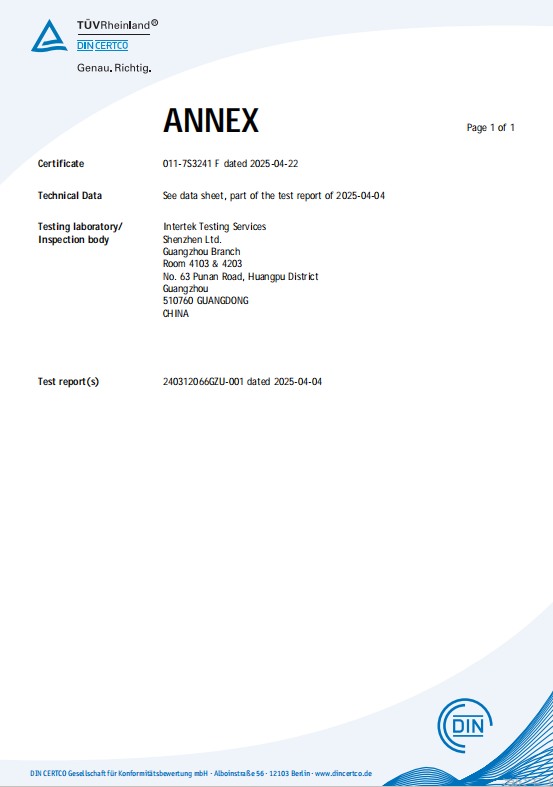
A flat plate solar collector uses a glazed absorber behind a cover, with insulation and a frame. Kesun Solar FPC2.0 and FPC2.5 models are certified under Solar Keymark 011-7S3241 F by DIN CERTCO, tested to DIN EN 12975:2022-06 and DIN EN ISO 9806:2018-04, with validity to 30 April 2030. In sizing, flat plate collectors are evaluated where the roof can carry a rigid glazed panel, where the field operates at moderate temperature differences, and where diffuse light is a meaningful part of the resource. Certified performance data gives the reference output; the design then adjusts for tilt, orientation, row spacing, shading and pipe runs.
Vacuum tube solar collectors
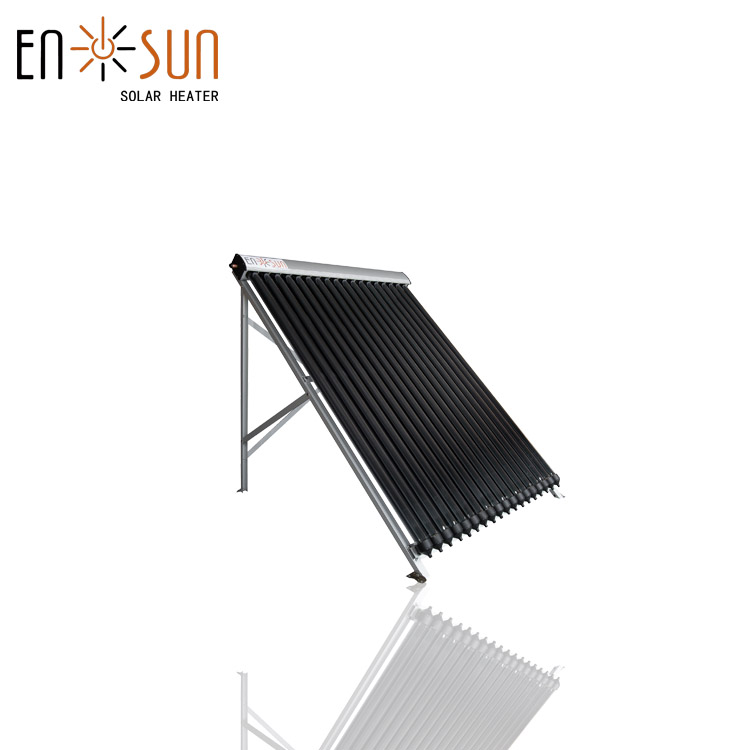
Evacuated tube collectors, such as the HSC10 to HSC30 range certified under Solar Keymark 011-7S3325 R (valid to 30 November 2030), place the absorber inside evacuated tubes, which limits heat loss from the absorber to the surroundings. They are evaluated where the temperature difference between absorber and ambient is large, where wind or cool nights matter, and where the roof geometry suits a tube array. The documented 80-room hotel case described below used high-adaptability vacuum heat collection modules, selected for corrosion and weather resistance in the hot-rainy Southeast Asian climate.
PVT hybrid panels and PV solar water heaters
PVT panels are photovoltaic-thermal collectors: they deliver heat and electricity from the same roof area, so the field has two outputs to place rather than one. Kesun Solar PVT430 to PVT670 models are certified under Solar Keymark 011-7S3240 P, valid to 30 January 2030. Adding PVT changes the calculation because the electrical output must be usable on site while the thermal output still has to match the storage and the draw profile. A PV solar water heater (PV Series) is specified through a different route: the PV Series appears in PED verification of conformity ICR/VC/HM2605327 and in LVD and EMC verification ICR/VC/HM2605326, not in the collector certificates above.
Table 1. Documented collector options and the sizing question each one changes.
| Collector option | Documented models | Certification reference | What it changes in the sizing calculation |
|---|---|---|---|
| Flat plate solar collector | FPC2.0, FPC2.5 | Solar Keymark 011-7S3241 F; DIN EN 12975:2022-06 and DIN EN ISO 9806:2018-04 | Gross roof area per unit of absorbed heat; rigid glazed mounting; moderate temperature operation |
| Vacuum tube collector | HSC10 to HSC30 | Solar Keymark 011-7S3325 R | Array layout; performance where absorber-to-ambient temperature difference is large; used in the documented hotel case |
| PVT hybrid panel | PVT430 to PVT670 | Solar Keymark 011-7S3240 P | Roof area shared between thermal and electrical output; thermal output must still match storage and draw |
| PV solar water heater | PV Series | PED ICR/VC/HM2605327; LVD and EMC ICR/VC/HM2605326 | Pressure-equipment and electrical safety scopes; the electrical supply becomes part of the system design |
Certification references confirm model scope and test standard. They do not predict a specific hotel solar yield.
Step 1 — Fix the daily load and the peak-hour draw
Daily heat demand for domestic hot water is calculated as daily hot-water volume in litres × temperature rise in kelvin × 1.163 ÷ 1000, which gives kilowatt-hours. The 1.163 Wh per litre per kelvin is the standard volumetric heat capacity of water. The formula is simple; the inputs are not, because volume depends on occupancy and fixture use while the temperature rise depends on the cold feed and the delivery set point, both of which vary by season.
Then split the total into a draw profile. Hotel demand is not spread evenly: a large share arrives in a short morning window, a second block arrives in the evening, and public bathing areas add a simultaneous load that a residential profile never sees. The daily total sets the collector field. The peak-hour figure sets storage volume, reheat capacity and backup. Confusing the two is the most common source of undersized hotels.
Step 2 — Set the solar fraction and size the field
Solar fraction is the share of annual demand the field is expected to supply. It is a commercial decision as much as an engineering one. A higher fraction needs more collector area and more storage, and past a point the marginal gain falls because surplus heat in low-demand periods has nowhere useful to go. The brief should state the target fraction explicitly instead of leaving it to the supplier.
For each candidate collector, the calculation takes the certified performance parameters, applies site irradiance, tilt, orientation, shading, row spacing and system losses, and returns the gross area needed to deliver the target solar heat. Data from EN 12975 and ISO 9806 testing is a reference measured under defined conditions; it does not replace a site-specific yield estimate. Compare the result against the roof area actually available after plant, walkways, parapets and structural zones are deducted, not the nominal building footprint.
Step 3 — Size storage against peak draw, not daily total
Storage does three jobs. It bridges the gap between collector production and hotel draw, it supplies the peak-hour volume the field cannot produce instantaneously, and it gives the backup heat source a stable body of water to work from. Sizing it as one day of demand alone is a common error, because a tank that matches the daily total can still be too small for the peak hour and unnecessarily large for the recharge period.
The tank types in a hotel plant are not interchangeable. A solar hot water tank, also called a solar hot water cylinder, stores potable water heated by the collector loop, directly or through a heat exchanger. A buffer tank holds water in the solar or heating loop to smooth return temperatures and protect the backup source; it is not necessarily a potable vessel. A DHW boiler or heat pump tank is the auxiliary vessel that carries the backup load. The specification has to name which vessel is being sized and what it may contain.
Material and pressure class belong in the same decision. Kesun Solar PWT200 and PWT300 storage tanks hold Intertek type examination test reports to EN 12897:2016+A1:2020, numbered 251023056GZU-001 and 251023056GZU-002. The company also added 2205 duplex stainless steel tanks to its production lines, supported by an Intertek performance test report on the stainless steel inner tank (251230069GZU-001). Those documents define what the tanks were tested against; they do not remove the need to match volume, pressure class and water chemistry to the project.
The trade-off runs both ways. A tank that is too small forces the backup to cycle through the peak, produces temperature swings at the tap and shortens the working life of the auxiliary equipment. A tank that is too large loses more standing heat, stratifies poorly and holds potable water for longer. Stored potable water at hotel scale also carries a temperature-management obligation: set points, recirculation and monitoring must follow local code and the project water-safety assessment, and storage volume affects how easily that regime can be held.
Step 4 — Couple the field and the tank
The two calculations meet at the recharge rate. A tank that is large relative to the field sits below its useful temperature for long periods in shoulder season. A field that is large relative to the tank reaches stagnation temperature and either stagnates or dumps heat. The practical question is how many hours of useful sun the field needs, on a design day, to recharge the volume drawn overnight and at breakfast while the hotel keeps drawing. That answer sets the relationship between field area and storage volume, and it is specific to the site, the collector and the draw profile.
Control belongs inside that relationship. Differential controllers, sensors at more than one tank height and pump or valve logic decide whether storage stratifies usefully or mixes. The documented hotel case uses smart temperature adjustment; a specification should state what is controlled, where the sensors sit and what the fallback behaviour is, not only the tank volume.
Step 5 — Integrate auxiliary regional heating
A system sized for a solar fraction is, by definition, not sized for the worst week of the year. Auxiliary regional heating covers the deficit. The documented 80-room hotel system supports auxiliary regional heating alongside its all-day solar supply and replaced the hotel traditional electric and gas heating equipment.
The backup is sized on the design-day deficit, not the annual average: the gap between peak-day demand and what the field and storage deliver on that day. Three placement decisions follow. Pre-heating upstream of solar storage raises the incoming temperature and reduces available solar gain. An immersion heater inside the vessel adds capacity where the water is already stratified. A downstream instantaneous top-up protects delivery temperature at the tap. Each choice changes storage volume, control set points and plant redundancy.
The configuration then has to be fixed. The supplied application notes allow direct or indirect circulation, passive thermosiphon or forced circulation with pumps, and electric backup or heat pump linkage, with control strategy depending on model and project design. Freeze protection, water-quality treatment, corrosion-resistant materials and roof load-bearing must be resolved before the configuration is frozen, not after the order is placed.
Step 6 — Write the specification the factory will build to
Hotel orders usually fail at the handover between design team and factory, not in the calculation. The specification should carry these items in a form that can be quoted line by line:
- Load schedule: daily volume, peak-hour volume, delivery temperature and cold feed range.
- Collector type and model family, with the certification reference that applies.
- Field area, layout, tilt, orientation, row spacing and mounting method.
- Storage: volume, potable or buffer duty, pressure class, material, stratification and sensor positions.
- Backup: type, capacity, energy supply and the control sequence that brings it in.
- Hydraulics: direct or indirect, forced or thermosiphon, pump head, pipe material, expansion and safety devices.
- Site conditions: wind and rain exposure, corrosion class, freeze risk and roof load capacity.
- Controls and monitoring: sensors, set points, alarms, data logging and remote access.
- Documentation: test reports, certificates, O&M manuals and the spare-parts list.
- Commercial terms: MOQ, lead time, Incoterms, inspection and payment.
Customization is where those items become a production instruction. Kesun Solar offers OEM, ODM and full customization, with options spanning tank capacity, collector type and complete system configuration for residential and commercial applications. Production capacity is 25,000 units per month, lead time is 20 to 35 days, and the minimum order quantity is one 40-foot container. The purchasing terms documented for the range are FOB or CIF delivery, pre-shipment inspection before loading and TT in advance. Quality control is 100% test, and after-sales support is remote.

The 42,000 m² Haining facility supports that work with high-pressure automatic foaming, robotic packaging, TIG, high-frequency, laser and butt welding, and an in-house laboratory for salt-spray and pulse testing. The company lists a 15-engineer R&D team alongside that production base.
What the documented 80-room hotel case shows
One documented commercial hotel project is the reference for this guide. The system provides all-day domestic hot water for 80 guest rooms and public bathing areas, supports auxiliary regional heating, and replaced the hotel traditional electric and gas heating equipment to meet stable daily heat demand. Reported outcomes are a stable service life of more than 15 years, electricity and gas costs cut by more than 40%, constant-temperature hot water with minimal failures, and lower carbon emissions supporting green-hotel compliance.
The equipment highlight is high-adaptability vacuum heat collection modules with corrosion and weather resistance for the hot-rainy Southeast Asian climate, an integrated design for easier installation and low-cost maintenance, and smart temperature adjustment for small and medium commercial projects.
Those figures are properties of that project, not a guarantee for another building. The 40% saving depends on the fuel replaced, local tariffs, occupancy, climate and operation. What transfers is the sizing sequence — load, solar fraction, field, storage, backup, specification — and the requirement that each step be documented.
Frequently asked questions
Which collectors and water heaters suit an 80-room hotel?
Kesun Solar HSC series solar collectors are matched with CPS-F-J and CPS series pressurized solar water heaters for hotel and commercial buildings that need stable large-volume domestic hot water. The documented 80-room case used vacuum heat collection modules; flat plate and PVT options remain available where roof area, climate and electrical use justify them.
How do collector type and tank capacity interact?
They are linked by the recharge rate. A tank that is large relative to the field stays below useful temperature in shoulder season, while a field that is large relative to the tank reaches stagnation. The design question is how many hours of useful sun the field needs to recharge the volume drawn at peak while the hotel keeps drawing, and that answer sets both.
Is auxiliary heating still needed if the system is sized correctly?
Yes. A system sized for a solar fraction is not sized for the worst week, so auxiliary regional heating covers the design-day deficit. The documented hotel system supports auxiliary regional heating, and the backup should be sized on the peak-day gap between demand and what the field and storage deliver.
What can be customized, and what are the order terms?
OEM, ODM and full customization cover tank capacity, collector type and complete system configuration for residential and commercial projects. Monthly capacity is 25,000 units, lead time is 20 to 35 days, and the MOQ is one 40-foot container. Documented terms are FOB or CIF, pre-shipment inspection before loading and TT in advance.
How is storage quality verified?
The PWT200 and PWT300 tanks hold Intertek type examination test reports to EN 12897:2016+A1:2020, and the stainless steel inner tank has an Intertek performance test report. The collector ranges carry Solar Keymark certificates: FPC2.0 and FPC2.5 under 011-7S3241 F, HSC10 to HSC30 under 011-7S3325 R, and PVT430 to PVT670 under 011-7S3240 P.
Can every hotel expect a 40% energy-cost reduction?
No. The documented case reports a reduction of more than 40% after replacing electric and gas heating. Another hotel result depends on the fuel replaced, tariffs, occupancy, climate and operation; the sizing method transfers, the percentage does not.
Conclusion
Sizing an 80-room hotel solar water heater comes down to a paired calculation: a collector field sized on daily heat and solar fraction, and storage sized on peak draw and recharge. Collector type changes roof area, operating temperature and climate behaviour; tank type and volume change peak capacity, backup duty and the water-safety regime. Neither can be fixed independently, and neither can be read from the room count.
Kesun Solar builds the collector, tank and configuration options discussed here and documents them with Solar Keymark, PED, LVD/EMC and Intertek test references. Project teams moving from evaluation to execution can use the 2025 catalogue to match product families and certification scopes to the specification.
Next step: download the Kesun Solar 2025 catalogue (PDF) for model ranges, tank options and certification references, or visit kesunsolar.com for company information.
Have Questions or Need More Details?
Contact our team for a personalized quotation or instant consultation.
Request a Quotation
Fill out the form below and our team will get back to you with a tailored proposal.
WhatsApp Direct Chat
Prefer to chat in real-time? Message us on WhatsApp for instant assistance & quick answers.
- Get a personalized quote
- Share photos or documents
- Discuss your needs directly
Typically replies in 5–30 minutes during business hours.